

Executive summary: Utilities are investing in digital transformation at unprecedented speed, but governance often lags behind. A unified IT/OT program management office (PMO) provides the structure needed to manage risk, meet regulatory demands, and deliver lasting operational value.
6-minute read
Utilities are investing heavily in digital platforms, automation, and predictive analytics. Their goal: to improve reliability and streamline operations while meeting growing expectations from both regulators and customers. The U.S. digital utility market is expanding rapidly, growing at nearly ten percent each year, and it’s expected to reach more than $107 billion by 2034.
But as modernization gains momentum, governance hasn’t always kept pace. As information technology (IT)—which supports data, analytics, and enterprise systems—converges with operational technology (OT)—which controls physical assets such as substations, meters, and control systems—utilities face a complex network of systems, vendors, and stakeholders, often without a unified structure for oversight. The result is siloed projects, inconsistent reporting, and limited visibility across platforms.
Real progress takes more than new technology. Utilities need a governance structure that connects strategy, operations, and compliance across the enterprise. An IT/OT program management office (PMO) provides that structure, aligning IT, OT, and regulatory priorities under shared standards, coordinated reporting, and clear accountability to deliver outcomes that are reliable and built for long-term compliance.
Table of contents (click to expand)
- The complexity challenge: When systems outgrow oversight
- Why the IT/OT PMO is the missing link in modernization
- From administration to integration: The modern IT/OT PMO
- Case in point: Building governance for a major U.S. utility
- The impact of governance-first modernization
- Governing the path to modern, resilient operations
The complexity challenge: When systems outgrow oversight
As utilities expand their digital capabilities, the line between IT and OT grows increasingly thin. Many legacy control systems, designed decades ago for isolated environments, now interact with enterprise platforms, cloud applications, and AI-driven tools. This evolution opens powerful new opportunities for data sharing, automation, and predictive maintenance, but it also creates deep interdependencies across systems and teams.
In many organizations, the pace of transformation has outstripped the frameworks designed to manage it. Oversight remains fragmented across IT, OT, and operations, where overlapping initiatives often advance without shared governance or visibility. Decision-making stays siloed, compliance efforts are often reactive, and risk management depends on informal coordination rather than structured processes.
That limited visibility can amplify risk. A single configuration change in one platform can cascade through connected systems, disrupting operations or triggering downstream integrity issues. Inconsistent reporting across technology and operations limits leaders’ visibility, slowing decisions and complicating communication with regulators.
Modernization efforts can lose cohesion across teams, even when leadership commitment is strong. Projects move forward independently, duplicating effort or introducing new risks, while the connection between investment, performance, and accountability weakens. Without unified governance, utilities risk falling short of their modernization goals and of the expectations set by executives, regulators, and the communities they serve.
To address these challenges, establishing an IT/OT PMO can close these gaps by uniting leadership, technology, and compliance under a single framework for decision-making and oversight. It transforms governance from a reactive function into a proactive enabler of modernization.
Article continues below.
Compliance as a Service (CaaS) ebook
Get expert insights on how to hit the mark with scalable compliance operations.
We will never sell your data. View our privacy policy here.
Why the IT/OT PMO is the missing link in modernization
An IT/OT PMO enables utilities to align leadership, processes, and technology under shared objectives that connect modernization strategy with day-to-day operations. When implemented effectively, the PMO establishes a common language among technology teams, control center operators, and business leaders, ensuring that every initiative supports enterprise goals and regulatory commitments.
Many see governance as bureaucracy, an added layer that slows innovation. In practice, it’s the opposite. Effective governance brings clarity and accountability to decision-making—for example, by defining who owns outcomes at each stage. It provides the structure utilities need to innovate confidently while maintaining reliability and compliance.
A mature IT/OT PMO puts these principles into action. Serving as a single point of coordination, it delivers:
- Clear decision pathways and escalation channels: Defined roles and responsibilities reduce ambiguity and enable faster, better-informed decisions.
- Standardized reporting and visibility across the enterprise: Consistent metrics and dashboards give executives, program leads, and regulators a transparent view of progress and performance.
- Proactive management of risks, dependencies, and regulatory obligations: Potential issues are identified early, with mitigation plans built into the program lifecycle.
A well-structured IT/OT PMO functions like a control room for transformation, keeping every modernization initiative aligned and accountable. It translates strategy into coordinated action, turning modernization goals into results that leaders can measure and trust.

How IT/OT convergence is optimizing asset management
Discover how IT/OT convergence is transforming asset management by improving visibility, reliability, and decision-making across utility operations.
From administration to integration: The modern IT/OT PMO
Traditional PMOs have long been essential for managing schedules, budgets, and milestones. In today’s utility environment, their role is expanding as they link program delivery with enterprise strategy, operational priorities, and regulatory expectations.
Modernization programs now span control systems, enterprise applications, and compliance frameworks that must function as one ecosystem. The modern IT/OT PMO bridges these domains, integrating strategy, technology, and regulatory oversight to ensure that modernization delivers tangible value across the organization.
Acting as a strategic integrator, the IT/OT PMO adds value on several levels:
- It aligns modernization programs with operational and regulatory objectives. It connects technology initiatives to business outcomes, ensuring every investment supports reliability, safety, and compliance.
- It provides visibility across IT and OT systems. Shared dashboards and metrics reveal interdependencies and progress, helping leaders make timely, informed decisions.
- It facilitates collaboration across teams. Engineers, control center operators, and executives work from the same information, closing gaps between planning and execution.
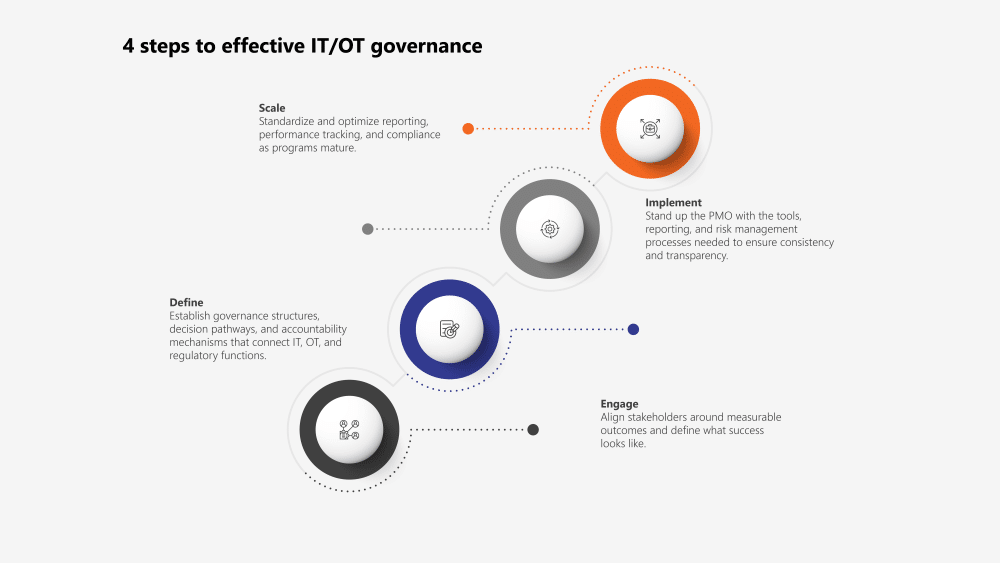
This level of integration requires structure and discipline. Logic20/20 applies this philosophy through a structured, four-phase framework that helps utilities institutionalize effective governance:
- Engage: Align stakeholders around measurable outcomes and define what success looks like.
- Define: Establish governance structures, decision pathways, and accountability mechanisms that connect IT, OT, and regulatory functions.
- Implement: Stand up the PMO with the tools, reporting, and risk management processes needed to ensure consistency and transparency.
- Scale: Standardize and optimize reporting, performance tracking, and compliance as programs mature.
This structured approach elevates governance from an administrative task to an enterprise capability that supports continuous modernization.
Article continues below.
Case in point: Building governance for a major U.S. utility
A major U.S. utility undertaking a multi-year grid modernization program faced a familiar challenge: multiple initiatives were advancing in parallel without a unified framework for decision-making or oversight. Each team managed its own priorities, reporting, and timelines. While individual projects showed progress, leadership lacked a consistent view of how those efforts connected to enterprise goals, operational readiness, or regulatory commitments.
To bring structure and alignment, the utility partnered with Logic20/20 in establishing a cross-functional IT/OT PMO that unites business, technology, and control center operations under a single governance framework. The PMO introduced standardized reporting, clear decision pathways, and proactive risk management processes that link daily execution to strategic objectives. That kind of transparency gives regulators and executives reliable, evidence-based visibility into progress and compliance.
The results were transformative:
- Predictable delivery: Modernization programs stay aligned with scope, cost, and compliance milestones.
- Enterprise visibility: Leadership gained real-time insight into progress, dependencies, and risks.
- Proactive risk management: Teams identify and resolve potential issues before they can escalate.
- Scalable governance: The PMO established a repeatable model that the utility now applies to future modernization initiatives.

The cornerstones of grid modernization: Overcoming challenges for success
Explore the key cornerstones of grid modernization and how utilities can overcome common challenges to achieve long-term reliability and resilience.
The impact of governance-first modernization
When governance takes the lead, modernization becomes more predictable and transparent, with outcomes that last. A governance-first approach gives utilities the structure to coordinate complex programs, manage risk proactively, and demonstrate accountability across every level of the organization.
With an established IT/OT PMO in place, utilities gain more than operational consistency. Governance creates strategic alignment across programs, enabling leaders to prioritize investments, manage risk, and adapt with confidence. Clear decision pathways and standardized reporting accelerate progress, while auditable frameworks ensure modernization stays transparent and repeatable over time.
Effective governance fosters trust—internally among executives, program teams, and operators, and externally with regulators and public stakeholders. When leadership demonstrates transparency and compliance, stakeholders gain confidence in the utility’s ability to manage modernization responsibly and deliver lasting value.

Designing the roadmap to utility grid modernization
Discover how a well-defined roadmap helps utilities navigate the complexities of grid modernization and turn strategy into measurable progress.
Governing the path to modern, resilient operations
In utilities, modernization achieves its objectives when IT and OT operate as one. The IT/OT PMO provides the governance structure that makes this possible, aligning leadership, technology, and compliance around clear, lasting outcomes. It fosters accountability and collaboration, ensuring that teams across the organization make decisions based on shared data and consistent reporting.
By institutionalizing governance through the PMO, utilities gain stability and flexibility. They can adopt new technologies, respond to evolving regulations, and manage growing complexity with confidence. Over time, this unified approach keeps modernization resilient, ensuring that digital investments deliver lasting value to customers, regulators, and communities alike. That’s how strong governance turns modernization into momentum.
You might also be interested in …

Digital transformation in energy and utilities: Powering the future of energy and innovation
How digital transformation is revolutionizing the utility industry by enhancing efficiency, sustainability, and customer satisfaction

Rebuilding resilience: A data-first approach to utility risk management
How a Northwest utility built an integrated data and analytics ecosystem that improves visibility, speeds up decision-making, and strengthens community safety

Cloud migration for utilities: Navigating innovation & regulation
How utilities can address tough questions regarding cloud migration and enable a smooth transition to cloud-based operations for enhanced efficiency and innovation

Strengthen modernization through unified IT/OT governance
Logic20/20 helps utilities bring structure, transparency, and accountability to grid modernization with a dedicated IT/OT Program Management Office (PMO) framework. Our experts deliver lasting value through:
- IT/OT governance design and implementation
- Cross-functional program management and oversight
- Standardized reporting and risk management frameworks
- Regulatory alignment and audit-ready compliance